Simple Feed
April 8, 2020
Spieth Fishes While Willett Lands A Slippery Masters

When you’re the 2015 defending Masters champ and you have a muscle spasm on Augusta National’s No. 12 on Sunday, the writers go from being handed Jordan Spieth to getting Danny Willetted. Historic collapse, but it’s happened before and will happen again. Just ask Sam Snead and Ben Hogan and Arnold Palmer and … Greg Norman.
This ran originally in April of 2016 in The Times and The News-Star.
By Teddy Allen
AUGUSTA, GA – Turns out that at Augusta National, Jordan Spieth can’t walk on water. Sometimes, he can’t even hit golf balls over it.
In a terrifically quick-turn flip-flop, Spieth saw a seemingly safe lead and his hopes of defending his Masters title drown late Sunday in the same amount of time it takes to say “quadruple bogey.” He walked to the back nine winning by five — and lost by three.
Taking advantage was 28-year-old wiry new father Danny Willett, a man who wouldn’t have played this week had his son not been born a week early. Sunday, the second-time Masters participant was the one who delivered, the champ of the 80th Masters due to a steely back-nine 33 and overall 67 for a 283 total that beat both Spieth and Lee Westwood by three.
“It all happened very, very quicky, obviously,” Willett said. “We went from behind, to two in front. It was all a bit surreal.”
Surreal must mean something like this: defending champ Spieth, who a day earlier had become the first player in history to lead the Masters outright for seven consecutive rounds, stood on the 12th tee at Augusta National in the late afternoon with a 9-iron in his hands and the magic he’d made here slipping through his fingers.
In each of his three Masters appearances, Spieth had played in Sunday’s final pairing. He was a runner-up in his first Masters two years ago, then won last year’s championship in record fashion. As he did in 2015, he’d led wire-to-wire again going into Sunday: his lead was a stroke when the day began, then grew to five when he finished a front-nine, 4-under 32.
For the past three springs, the first full week in April was magic in Augusta for Spieth. And the same was true this week – until the back nine Sunday and, most spectacularly, until the 12th tee box, the one that sits 155 yards from the hole, the one with Rae’s Creek guarding a small green.
What happened was that Spieth bogeyed 10 and 11 but still held a three-shot lead. But … his tee shot on 12?: water. Next shot: chubby, no chance, water. Third shot: back sand trap. Score: 7.
“I didn’t take that extra deep breath and really focus on my line on 12,” said Spieth. “Instead I went up and put a quick swing on it.”
He had the right club but not the “right swing” to get the ball flight he wanted, he said. Plus, “that hole, for whatever reason, just has people’s number.”
Again, the math is remarkable for a player of Spieth’s caliber: He’d walked off 9 with a five shot lead, approached 12 with a three-shot lead and left 12 two strokes behind. Despite birdies on 13 and 15, he came in at 41 and finished with a 1-over 73, (so yes, that’s 32-41, or an extra stroke a hole on the back as compared to the front).
Somewhat lost in the fascination with how quickly that had happened – Superboy broke his leg? – was the equal reality that Willett, a preacher’s son from Hackenthorpe, which isn’t in Georgia or the United States but is instead, for some reason, in England, was shooting his tied-for-the-day’s-best 67, and only three pairings in front of Spieth.
“I’m going to have a reasonable chance,” Willett said on the eve of his victory, “but I’ll have to do something special.”
The only Englishman to win the Masters besides Nick Faldo, the delightful, thin, steady, willowy Willett birdied 10 and 13 just prior to Spieth’s wheels coming off, then birdied 15 while Spieth was feeding the creek on 12.
Suddenly, a championship was up in the air. Even after the bogeys on10 and 11, Spieth still had the lead by three, and with two par-5s to play. Except for Willet and Dustin Johnson, whose 71 gave him a share of fourth Sunday, the other four players within three shots of the lead after Saturday went the other way all afternoon: for LSU star Smylie Kaufman (81 Sunday), Bernhard Langer (79), Hideki Matsuyama (73) and Jason Day (73) disappeared, leaving the charging Westwood (71) and the too-little-too-late duo of Paul Casey and Matthew Fitzpatrick, who matched Willett’s 67, tied for fourth and seventh, respectively.
“It was a weird day for both of us,” said Kaufman, 24, who was in the final pairing with his buddy Spieth.
It was, as Willett said, surreal and special. But mostly, maybe it was weird. Golf fans know that Greg Norman blew the largest 54-hole lead in Masters history, six shots, and Nick Faldo took advantage; his 67 earned Faldo a third Green Jacket. How does that compare to Spieth losing a 5-shot lead with seven holes to play? Since it was quicker, it seems less the passion play that Norman’s did. Still, it was weird, and the result was the same.
On the bright side for Spieth and golfers everywhere, it helps to remember that Sunday’s shenanigans mean that Spieth joins a stellar list of great ones who let great big ones get away:
Norman collapsed here in 1996;
Sam Snead made 8 on the final hole of the ’39 U.S. Open and lost in a playoff; Ben Hogan lost here by a stroke with a three-putt on the 18th in ’46, and another 18-green three-putt in that year’s U.S. Open cost him a spot in that playoff; Snead missed a putt of less than two feet to lose the ’47 U.S. Open; and finally, Masters hero Arnold Palmer, the most everyman-golfer of them all, hit into the bunker on the 18th here in ’61 and double-bogeyed when a par would have won it. Because of it, he missed that chance at back-to-back Masters wins.
Sunday, so did Spieth.
-30-
April 8, 2020
The Hammer, Macbeth, and that night in Atlanta
By JOHN JAMES MARSHALL/Designated Writers
If you are baseball fan, you are kind of obligated to know the significance of April 8. It’s one of those I-know-where-I-was dates in your sports memory bank.
And when April 8 rolls around every year, a simple mental acknowledgment will suffice. No need to take a day off from work.
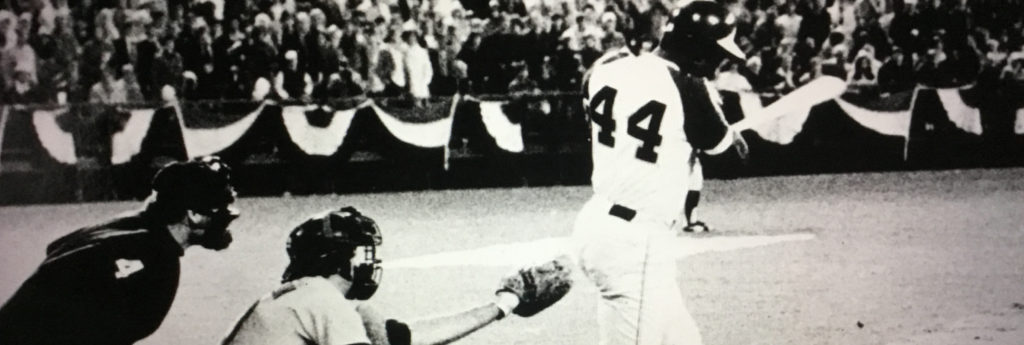
It was on April 8, 1974, that Hank Aaron — The Hammer — hit the home run that broke Babe Ruth’s record which, at the time, was the most revered record in all of sports (and it wasn’t even close).
There are so many major and minor subplots to that night at Atlanta Stadium (see, there’s one! It wasn’t re-named Atlanta-Fulton Country Stadium until the next year). There is baseball significance, racial significance, cultural significance, and Shakespearean significance. Wait … how’s that again, you say?
Yes, the night Hank Aaron belted an Al Downing pitch in the fourth inning over the left field fence, I was just where you’d expect me to be. Backstage in the Jesuit High School gym getting ready to deliver one of my four lines as Angus in the Shakespearean play “Macbeth.”
“He did it,” somebody whispered to me and let me assure you he wasn’t referencing McDuff’s guilt in the whole beheading situation. (Who couldn’t have seen that coming a mile away?)
No, I knew exactly what that meant and I had to take a moment to let it sink in that I had missed one of the great moments in sports history in order to walk on stage and tell some dude in bad clothing that he had ascended to the Thane of Cawdor.
“We are sent
To give thee from our royal master thanks;
For The Hammer has ripped a 1-0 fastball,
and gone yard.”
It is hard to imagine that any sports record will ever match the buildup of Aaron’s homer. Funny thing is, there was a time when baseball fans thought it was Willie Mays who was going to break the record. After the 1966 season, Mays was in second place with 542 homers. He was 35 years old at the time but he had just hit 37 homers that season. You figure if he comes close to that for the next few years, it’s going to get interesting.
At that same time, Aaron was in 10th place with 442.
But Willie rapidly began to decline — his next five season home run totals were 22, 23, 13, 28, 18 — and by the end of the 1971 season, Aaron was now in third place (he hit 47 that year). He was only seven behind Mays — and was three years younger.
Game on.
Aaron hit 34 when he was 38 years old and 40 when he was 39 to finish the 1973 season one behind Ruth. (Another side note — Aaron hit #712 in Houston and had a week-long home stand to end the 1973 season. But it wasn’t like Atlanta was whipped into a frenzy; there were crowds of 10,211 and 5,711 for two midweek games. Aaron did uncork No. 713 on a Saturday and 40,000 showed up for the final game on a Sunday, but all he did was get three singles to raise his average to .301.)
So there was only one story line when the 1974 season started but the Braves started on the road in Cincinnati. (Nice job, schedule makers; way to have a great sense of history.) Everybody knew he wanted to break the record at home and the Braves said they were going to hold Aaron out of the opening series. Commissioner Bowie Kuhn put the kibosh on that and ordered that he play in two of the three games against the Reds.
The Hammer went deep on his first swing on Opening Day to tie Ruth and then sat out the next day (“load management?”), meaning that he had to play in the third game before heading home to Atlanta. Here’s why I love Hank Aaron — on that day when he was forced to play, he struck out twice and had a groundout. Even as a 40 year old, do you know how many other times he struck out twice in a game that entire season? Two. Take that, Commissioner!
And on the next night, history was made in front of 53,775 people, none of whom were named Bowie Kuhn.
The racial taunts that Aaron endured are well known and he has always been a gracious and likable legend in baseball history. The U.S. Post Office estimated that he received 930,000 pieces of mail that year and Aaron admits most of it was kind. But hundreds of the letters were not.
When he broke the record, he was admired, but he was not loved like Willie Mays was. But as time has passed, Aaron has become a beloved figure, not only in baseball but in all of sports. He is no longer “the home run record holder,* but he still leads in career RBI and total bases — and hasn’t played since 1976.
It’s taken decades, but Hank Aaron has gotten what he deserved.