Simple Feed
December 21, 2020
Not an opt-imum situation for Independence Bowl
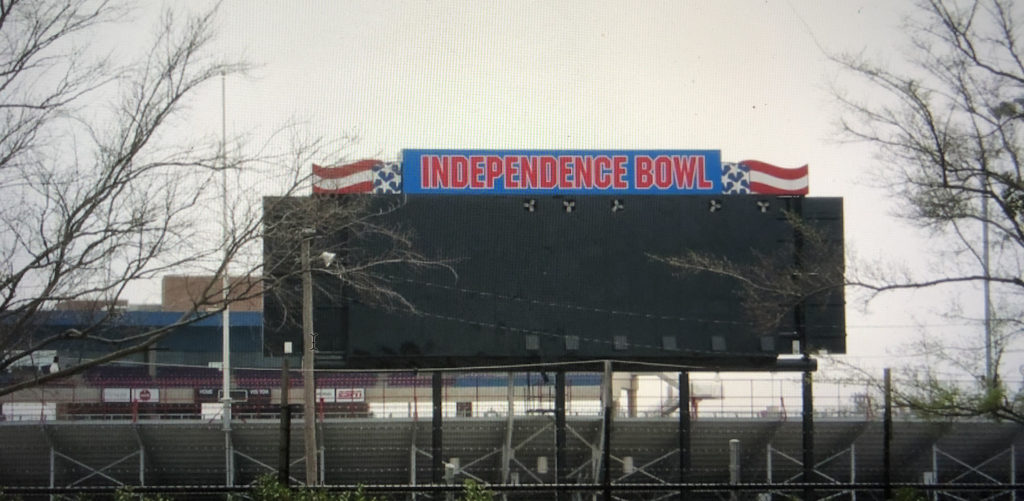
By JOHN JAMES MARSHALL/Designated Writers
The Little Bowl That Could finally couldn’t.
The announcement Sunday that there would be no Independence Bowl this year wasn’t really shocking or even mildly surprising. Nothing that has happened in the college football season of 2020 has gone by the book — as if there had even been a book in the first place — but that doesn’t do anything to ease the disappointment.
The Independence Bowl is touted as being the 11th oldest bowl in terms of continuous service but it’s the 1st oldest bowl in terms of dusting itself off following one body blow after another and teeing it up every December.
Except this one.
This might be a whole lot easier to take if there had been a bad guy in this whole deal. With team after team opting not to play in a bowl game, it didn’t take too much number crunching to figure out that there weren’t enough teams to go around to fill the bowls. First, the newbie bowl games (Fenway, Los Angeles) went by the wayside. Then teams, many of whom were way deeper into the calendar than they were accustomed to, began backing out.
Since there was a contractual tie-in with the Pac-12 Conference, the bowl held out hope that would stand up. But that conference, which apparently can’t make a decision on its own without asking the Big 10, fell apart like a cheap suit. Other bowls with tie-ins to the Pac-12 began to cancel, so the Independence Bowl began to move up in the rotation. There was the thought that UCLA — and its huge television market — might be the pick, which would have been a major coup. But the Bruins announced during the week that there would be no post-season.
Even though there was a one-year allowance for teams to go to bowls with a losing record, three Big 10 teams — including Nebraska — announced Saturday they wouldn’t be playing in the post-season, adding to the list of schools that grew to almost two dozen.
There are a lot of people and entities to feel sorry for in this whole sordid situation. Bowl officials put on a good face, but this has already cost them money they won’t get back. Needless to say, think of all the hard work that has gone into the game. Even with the delayed season, bowl officials were prepared to make it a go with only six days notice. Because they have always found a way before, no matter what the crisis.
But the saddest part of this is for Army, which accepted a bid as soon as it had its sixth win. That allowed the Independence Bowl to begin promoting the Cadets as one of the participants as they continued their season by finishing with. 9-2 record.
And then the collective rest of the college football world let them down. Think about it … they let Army down. Doesn’t seem right, does it?
It’s one thing to let down a team who suffered through a miserable season and was going to mail in a bowl appearance with a half-ass effort. But this was 9-2 Army who had been looking forward to this for two months, especially after beating Navy last week.
All you need to know about Army is that even after the Independence Bowl announcement, the school was still trying to line up an opponent to play.
“These young men haven’t quit all year and we surely won’t quit now,” Army athletic director Mike Buddie said in a statement. “They deserve better. Period. They have earned an opportunity to get 10 wins and, as we have all year, we will continue to fight to get them that opportunity.”
It’s one thing for players to opt-out of bowl games. It may not be right, but it’s becoming more and more acceptable. Fans don’t like it because they think players have an obligation. But these schools are members of a conference, who have negotiated the best bowl deals possible for its member institutions. To let them walk away and leave bowls hanging just doesn’t seem right. There’s no obligation there?
Just like the players, these schools do it because they can. This isn’t like passing on a NIT berth in basketball. There’s a lot more at stake.
For the Independence Bowl, it was bad luck, bad timing in a bad year.
But most of all, it was a bad virus.
In the long run, maybe it will be for the best. But when Saturday comes along and Independence Stadium is quiet, it’s just not going to feel right. Beyond that, who knows?
But if there is one thing we have learned every year since 1976, don’t ever bet against the Independence Bowl
December 11, 2020
Books of 2020: ‘GET YOUR HANDS OFF MY STIMULUS PACKAGE’

First ran in Sunday, December 6, 2020 issues of The Times and The News-Star.
Thought the pandemic would free up lots of time to do one of my favorite things: read stuff I want to read.
Like so many other things this year, it didn’t work out as we’d hoped and planned. Part of it was pilot error, part of it was having plenty of unforeseen work to do.
But like you, during the past nine months I’ve made the effort to read most of the virus-themed bestsellers, hastily written books like these:
LOCKDOWN!: Your Place or Mine?
1,501 Ways To Make Banana Bread
The Vaccine Two-Step: Let’s Give it a Shot
Why Masks Work
Why Masks Don’t Work
Why Masks Might or Might Not Work
1,501 Things To Do With Bad Banana Bread
I Know We’re Family—But Get Out of My Space!
Epidemiology for Beginners
Rioting for Beginners
Netflix for Beginners
Advanced Rioting and Netflix
Contact Tracing for Losers
Social Distancing for Loners
Buried Alive, Six-Feet Above Ground
And No. 1 for the 31st week in a row:
Get Your Greedy Hands Off My Stimulus Package
Like you, I’m sick of those. So I returned to the safety of non-viral literature.
Finished the Travis McGee series by John MacDonald, who passed away in 1986 at age 70 but not before he’d written dozens of crime and detective novels, including the 21-book McGee series. The series began with The Deep Blue Goodbye and ended with The Lonely Silver Rain, a wrap that I never saw coming but that was totally satisfying. The next-to-last book of the series is Cinnamon Skin, which has probably my favorite cover—obviously a female on a motorcycle by the ocean, but backlit—in the Random House Trade Paperback re-released series. Now I have to decide whether or not to read them all again or to actually try to be a mature adult and move on. Tough call…
Always try to read annually a couple by the late and great Elmore Leonard, witty and smart writer of crime fiction. This year it was Pagan Babies about a sort-of semi-on-the-run Catholic priest, and also Riding The Rap, featuring Raylan Givens of the “Justified” TV series. In this one he solves a kidnapping. Plus he’s funny, sharp as an Ole Miss khaki crease.
I read A Visit from the Good Squad by Jennifer Egan after reading rave review after rave review, but it was most un-rave to me. Still don’t really know what happened. Or care. Tried to read George Saunders’ Lincoln in the Bardo two years ago with the same result. Unless it’s a funny crime thing, I don’t get modern fiction.
Really enjoyed the historical fiction book Before We Were Yours by Lisa Wingate, based on the real-life satanic Georgia Tann and her Memphis Tennessee Children’s Home Society. That this could have happened in real life blows the mind. Will try this year to get my hands on the semi-sequel Before and After, the real-life stories of some orphans who survived the Society, written by Wingate and our friend Judy Pace Christie, former executive editor in Shreveport at The Times.
Finished the best trilogy I’ve read since Rick Atkinson’s on WWII; it’s by Nigel Hamilton and the final book of this FDR-focused saga is War and Peace: FDR’s Final Odyssey: D-Day to Yalta, 1943-45.
Stories I Only Tell My Friends by Rob Lowe is about his Forrest Gump-like road to stardom. Every time he turns around or moves with his family as a young man, he’s bumping into somebody “in the business,” one thing leads to another and he turns into Rob Lowe. Crazy.
Some other 2020 favorites are In Harm’s Way by Doug Stanton about the U.S.S. Indianapolis and the worst sea disaster in U.S. Naval history; The Call of the Wild by Jack London; The Soul of America by Jon Meacham; Big Little Lies by Liane Moriarty (guilty pleasure); Make Your Bed, a short book about “little things that can change your life—and maybe the world,” by Admiral William McRaven, U.S. Navy Retired; Countdown 1945 by Chris Wallace, about making the atomic bomb; Red Notice by Bill Browder, a true story of high finance and murder that reads like good mystery fiction, Russia and big money and all like that.
Listened to some Audible Originals, including The Home Front, hosted by Martin Sheen, about America on the mainland during WWII. Interesting and educational. Listened to a couple from Audible’s “Word and Music” series, one from Sheryl Crow (didn’t happen for me) and one by James Taylor titled Break Shot: My First 21 Years. Best book I listened to all year. Imagine James Taylor talking to you about the fairly overwhelming first two decades of being him, before he was “James Taylor.” It’s worth whatever you have to do to get your ears on this.
Second-best listen was Jerry Seinfield reading Is This Anything, six hours of different bits he’s kept over the years. If you’re a fan and I am, Is This Anything is something.
-30-