Simple Feed
December 13, 2019
THAT TIME LA TECH, THE U, AND CORSO CAME TO TOWN
By TEDDY ALLEN/Designated Writers
It was big doings back on August 30, 2003 when the Miami Football Hurricanes, still very much The U, cruised into town for what proved to be a day at South Beach against Louisiana Tech, a 48-9 loser in what was still, somehow, a semi-glorious night before 43,279 fans in Independence Stadium.
Miami would lose back-to-back mid-season games but still finish 11-2 as Big East Co-Champs and Orange Bowl champs with a win over Florida State. Tech finished 5-7 and won back-to-back games just once, immediately after losing to Miami.
Lot of talent of the field that night. Names like Gore, Winslow, Rolle, Vilma, and Wilfork in Miami jerseys. Tech had a dude named Luke McCown at QB who would play 14 years in the league.
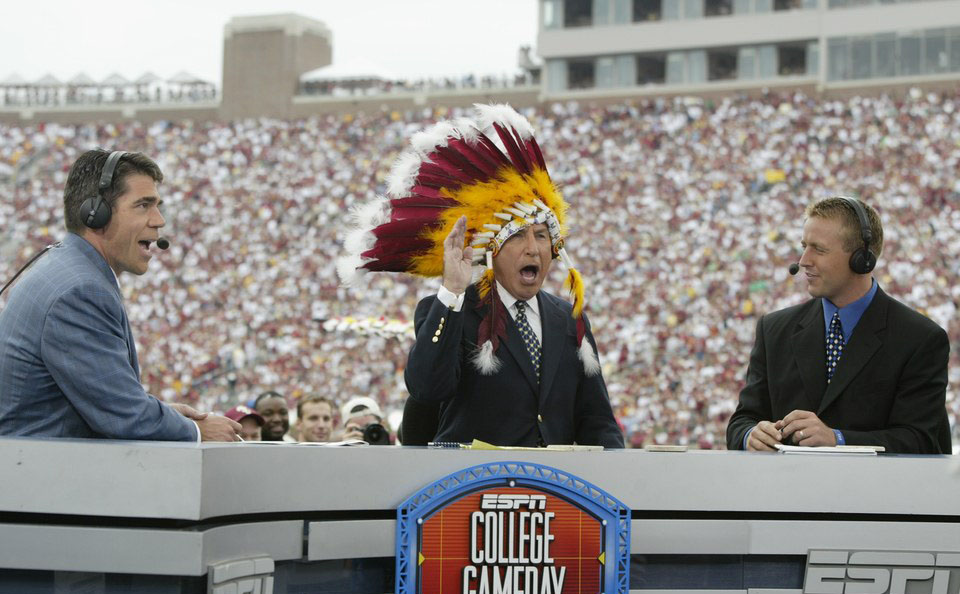
But the magic for many that night was in the booth. ESPN was in the house, and so was Lee Corso, the guy who puts on a mascot head each Saturday morning on College GameDay for ESPN. Or sometimes, as pictured here in a photograph by Craig Jones/Getty Images, puts on a Florida State (his alma mater) headress. In 2003, my then 13-year-old son Casey and I were Saturday morning disciples of the GameDay team of Chris Fowler, Kirk Herbstreit, and Corso, then a relatively new phenomenon in college football. And they are the ones who called the August 30th game in Shreveport.
I wrote in a column that Thursday before the game that Corso was the college game’s version of Santa Claus coming to town, and then my fingers wrote the following “song” that you can sing to that familiar tune. For Casey and all the other “little” dudes that got a charge out of him, I was pretty juiced that Corso’s trademark “Whoa!” and pencil were coming to town.
He’s bringing his guys
On his left and his right
Gonna talk football
Argue and fight
Lee Corso is coming to town.
His suit and his tie
His pencil in hand
Game day’s like Christmas
Wherever he am
Lee Corso is coming to town.
(Chorus, everybody!)
He knows when you are blitzing
He knows his offense too
He knows if you’re team’s bad or good
And he’ll share it all with you.
(“Whoa!”)
He’s the main man
The backbone and glue
Of the best football
Team on the tube
Lee Corso is coming to towwwwwn!
True, it’s not Hail to the Victors, but you get the point, which is Merry I-Bowl to all, and to all a good fight come December 26 when LA Tech and Miami meet again, this time at 3 pm in the Walk-On’s Independence Bowl.
-30-
December 12, 2019
When you’re way past wanting just your two front teeth

(This originally ran in the December 5, 2010 Sunday editions of The Times and The News-Star.)
We get up every morning hoping for something.
We hope to make enough money to pay the rent. Or we hope to do something fun. We hope our team wins. We hope he or she will notice us. We hope to make a difference, or we “hope to just make it through another day.”
We run on hope, whether we think about it or not. When we quit hoping, we quit living.
“If you don’t have hope, you don’t have Christmas,” the preacher told us. “If you don’t have hope, you don’t have life.”
If that’s true, hope better be standard equipment. But it’s not. Hope comes as an option only.
Good, then, that the Christmas season is about hope. No hope? No Christmas.
The lights. The tree. The Nativity scene. Symbols of hope. Pictures of hope. Even the presents are mysteries wrapped, hope in a package, hope on a small and non-eternal scale. “I hope grandma didn’t get me socks!?” Again!”
We’re told that the greatest of all things is love. Not faith or hope, each of which hit the tape at about the same time as the other. When you die, what you’ve had faith in will either be there – or it won’t. What you’ve hoped for will be realized – or it won’t. At that point, you’ll have use of neither. At that point, love has the stage to itself.
But in a world filled with “Why’s,” way down here, hope comes in handy. Sort of like air comes in handy.
We start out hoping for little things. A bike and a ball glove and my two front teeth. But you get older, and it’s a different ballgame. You hope for a better job. A better home. A home at all. Someone to love. Someone to even care.
There are days when all you want is hope. Or even a hint of it. I had a friend in that boat. His report from the doctor wasn’t good that day a couple of years ago.
But faithfully, the patient, my friend, did as he was told.
And miraculously, though the climb was steep with dips now and then, the news from the Houston hospital kept becoming more and more favorable.
Finally, one cool Saturday morning this fall, he called to say the doctor had found no cancer. The doctor even told him to come back not in three months, but in six. And after that, probably for not another year.
“A guy asked me back then, ‘What do you do when you find out you have Stage 4 cancer?’” my buddy told me. “And I said that the first thing you do is you get angry. And then you cry.
“And now I know what you do when they tell you you HAD Stage 4 cancer but you’re well now,” he said. “What you do is get really happy. And grateful. And then you cry again.”
There are different kinds of tears. Some – like the ones that come when you find out you’ve been granted more life to live – are liquid joy. They speak what we can’t say.
And there are tears of anger. Or fear. Or tears when healing doesn’t come. But Christmas means we don’t ever have to cry as those who have no hope. Because of Christmas, hope makes all the difference in the world.
-30-