Simple Feed
July 20, 2020
REMEMBERING A BRIDGE THAT BURNED TOO SOON

First ran in Sunday, July 19, 2020 editions of The Times and The News-Star.
If heat killed COVID, the virus wouldn’t have made it through the Fourth of July around here. This is a hot spot in more ways than one.
Speaking of heat and death, I was sizzling at a red light in Shreveport, corner of Pierremont and Gilbert, heading east and about to turn north, when I remembered that this spot is where I was, June 5, 1993 when the radio told me that Conway Twitty had collapsed on his tour bus the night before in Branson, Missouri, been taken to the hospital and died there in the early morning of an aneurysm.
Hurt me. He was only 59. When I got home that day — it was a Saturday morning — I took a physical knee. Can’t believe it’s been that long ago.
True, Conway had gone a bit pop on us by then. He had taken to recording gut-bucket drivel like The Rose and Tight-Fittin’ Jeans and Slow Hand (yes, a cover of The Pointer Sisters’ hit) and the awful Don’t Call Him a Cowboy (Until You’ve Seen Him Ride), a title embarrassing to even type, much less listen to.
But those stinkers did not discredit the fact that Conway Twitty was, by all accounts, good to all he met, a hard worker, and beloved by songwriters who called him “the best friend a song ever had.” A draft pick by the Philadelphia Phillies out of high school (but a draft pick by the United States Army at the same time), he’d hammered out real country hits in the 1970s and 1980s that stood the test of time. Monsters.
I See The Want To In Your Eyes. Linda On My Mind. You’ve Never Been This Far Before. The Games That Daddys Play. Hello Darlin’. Don’t Take It Away. Fifteen Years Ago. She’s Got A Single Thing In Mind. Songs I was singing before I knew what they meant. As late as 1986, he had his final of 50-plus Billboard No. 1’s with Desperado Love, co-written by Shreveport-Bossier’s Michael Garvin.
Plus all those duets with Loretta Lynn, like After the Fire is Gone, Louisiana Woman, Mississippi Man, and You’re the Reason Our Kids Are Ugly.
Strong.
And we haven’t mentioned a personal favorite from 1980, Standing on a Bridge That Just Won’t Burn, the reason for today’s essay.
It was around that time that Conway and the Twitty Birds showed up in Shreveport—he often came to Shreveport and Monroe—for a concert in Hirsch Coliseum. I was out of town but could always count on my friend Hilly to be my eyes and ears at any Hank Jr., Barbara Mandrell, Statler Brothers, or Merle Haggard concert I might miss, and he was my boots-on-the-ground for this memorable night.
Who opened, we don’t remember. Probably a Crash Craddock or a Billy Joe Spears. Maybe Loretta. Regardless, when the time came for Conway, the disco balls in vogue then started spinning and lights were flashing and a powerful voice announced to the packed house, “Ladies and gentlemen, the high priest of county music, Mr. Con-Way Twitty!”
“Half-dozen women fainted,” Hilly reported. “Had to drag ’em out of there. Not lyin’, son.”
Conway was hot as summertime in north Louisiana. This was in his perm period, hair-wise. He’d gone with the semi-pop perm after wearing his hair folded back with Vitalis all those years. He was a natural athlete and a natural showman.
Hilly said it went on like that pretty much the whole night, screaming and yelling and groping and pawing, as the Country Elvis—from Friars Point, Mississippi, by the way—growled out one line drive after the other before he finally got to Bridge That Just Won’t Burn, which goes in part like this:
“She’s a page of precious memories,
That I’ve tried hard to turn,
She’s standing on a bridge that just won’t burn…”
One of those hurtin’ deals.
So Conway’s at the edge of the Hirsch stage singing this song and women are straining to touch him, and Conway’s singing and touching hands as best he could, except this one lady couldn’t quite reach him. Hilly said she’s reaching and Conway’s reaching, like Michelangelo’s fresco of God reaching for Adam on the Sistine’s ceiling, and veins are visible in her neck and forearms and Conway can’t quite get to her but instead finally looks her in the eyes and growls to her through the microphone, deeply, “I’m sorry honey; I guess they must have burned the bridge.”
“And that did it,” Hilly said. “Screamed and fainted. They had to carry her out too.”
-30-
July 17, 2020
Old All-Star memories are all we have this week
By JOHN JAMES MARSHALL/Designated Writers
One of the downsides of all of this sports nothingness is that you lose track of the calendar. As the days and weeks drone on, you forget what should be going on and what has gone on. For example, the Olympics were supposed to start next week; instead, baseball is going to start. Who had that in the office pool a year ago?
This would have been All-Star Week for baseball — strangely enough, only the second ever to be played at Dodger Stadium — and Tuesday came and went and hardly anyone noticed. I’m not sure Major League Baseball even noticed. Whoever was in charge of officially calling off the game didn’t get around to it until July 3. (Which makes you wonder if he holding out hope on July 2 that it might actually happen.)
The All-Star Game has always been special to me but I hate to admit that it is less so than it used to be. I suppose that’s the way it is for a lot of things, but it really hits home with what the game has become. Or, in the case of this year, what it hasn’t become.
I can rattle off so many memories of the game from years gone by: Fred Lynn’s grand slam at Comiskey Park (1983) … Dave Parker throwing out everybody in sight from right field in the Kingdome (1979) … Fernando Valenzuela striking out Dave Winfield, Reggie Jackson and George Brett in a row and then giving way to 19-year-old Dwight Gooden in the next inning … 15 innings at Anaheim in 1967 and then 1-0 the next year in the Astrodome … Bo Jackson’s leadoff home run in 1989 that still hasn’t landed. OK, I’ll stop.
Actually, I won’t.
There are two even memorable All-Star Games for me and they happened in back-to-back years. But the bigger issue for me was that July almost always brought me pain and woe. As an American League fan, it was crushing to watch my people get dusted every year. The National League won a heart-breaking 19 of 20 games from 1963 to 1982. That’s a lot of summer nights of going to sleep hacked off.
But the one year in that streak that the American League won was 1971. The game itself wasn’t that great (6-4 win by the AL) as it was for the people playing in it. The NBA likes to claim that the ’92 Dream Team was the greatest assembly of talent in the history of sport, but you could make the case that the two greatest teams were on the same field at Tiger Stadium in Detroit that night. Your call:
American League: Five Hall of Fame starters (Carl Yastrzemski, Frank Robinson, Brooks Robinson, Rod Carew and Luis Aparicio) plus four more on the bench (Al Kaline, Harmon Killebrew, Jim Palmer and Reggie Jackson, who hit the most mammoth home run ever). Oh, and the pitcher? Mansfield’s own Vida Blue, who was on his way to a 24-8 record and a 1.82 ERA and the league MVP as a rookie that year.
National League: Could I interest you in this batting order? Willie Mays, Hank Aaron, Joe Torre, Willie Stargell, Willie McCovey and Johnny Bench. All are in the Hall of Fame. So are reserves Roberto Clemente, Lou Brock, Ron Santo, Steve Carlton, Juan Marichal, Tom Seaver and Ferguson Jenkins. Pete Rose should be.
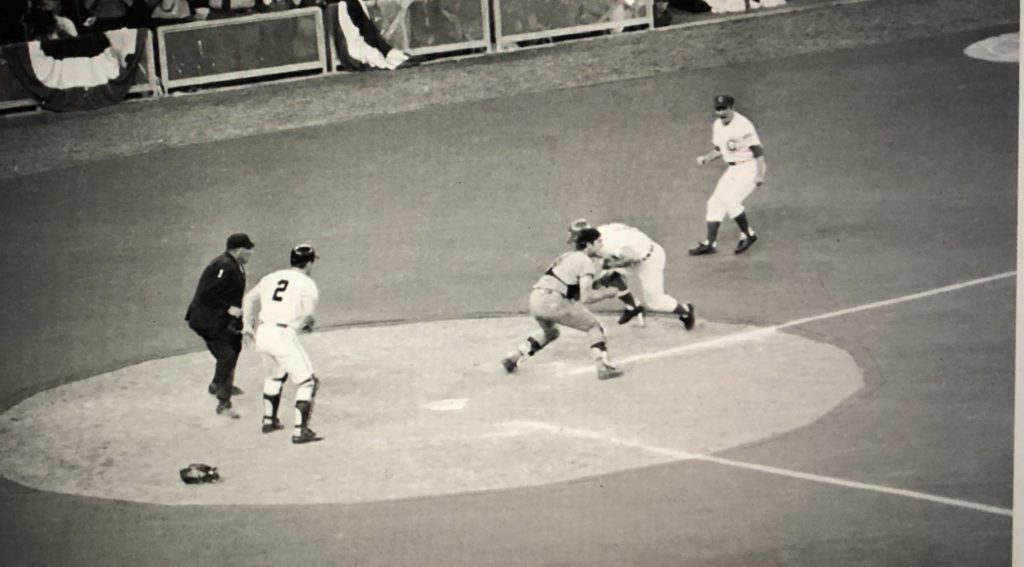
But this is also the 50th anniversary of the 1970 All-Star game, which is known for Rose running over Ray Fosse at home plate to win the game in the 12th inning. (By the way, waving Rose around third base was Leo Durocher.) Baseball likes to claim that when they played the All-Star Game for World Series home field advantage a few years ago that it made the game “mean something,” but they obviously failed the history lesson.
Rose running over the catcher at home plate in an All-Star is what happens when a game “means something.” It was the 12th inning and nobody was worried about running out of pitching or putting a runner on second base so everybody could go home.
The man in the on deck circle when that play happened was Dick Dietz of the San Francisco Giants. Dietz, who died in 2005, would later go ion to be a coach in the Giants organization and in 1992, he was with the Shreveport Captains. One night after I had covered a game at Fair Grounds Field, I asked him about that play and he remembered it as making “a sickening sound.” As you can see by the above picture, Dietz (#2) had a pretty good view of the play.
These days that play is illegal, which is probably a good thing.
Which is more than you can say for what the All-Star Game has evolved into.
Picture Source: Cincinnati Magazine