Simple Feed

DESIGNATED NOTE: This week, we will bring you remembrances of the four Final Fours we covered during the 1980s, back when authority figures allowed us to do such things. First: The 1982 Final Four in the New Orleans Superdome.
The 1982 Final Four was the first major event I ever covered. I was less than a year out of college and had covered a few LSU and Dallas Cowboys games, but mostly it had been the Shreveport Captains and Louisiana Tech games for me up until that time.
I’m not sure how I got the assignment – probably because I could save the Shreveport Journal some serious cash by staying at my cousin’s house in New Orleans for four nights.
You can’t believe how many storylines there were going into this Final Four, but I can promise you that a freshman from Wilmington, N.C. was not one of them. Once it was over – and for the 36 years since – Michael Jordan’s winning shot is what everyone remembers.
I was on the first row of press seating on the floor and even with the baseline, so Jordan’s shot came right at me. I knew it was in all the way. However, that was not the greatest vantage point to see what happened next. Georgetown’s Fred Brown inadvertently threw the ball to James Worthy as the Hoyas came downcourt to attempt to trump Jordan with a game-winning shot of their own. The problem with that? Worthy was on the other team. From my angle, I thought it had just been a nice defensive play instead of one so infamous.
I might not be able to remember what I had for lunch (just kidding … turkey and cheese sandwich on wheat bread), but I still remember plenty from that Final Four.
WE’RE TALKING ‘BOUT PRACTICE: When I walked into Friday’s practice session, I quickly realized this wasn’t exactly the Gold Dome. There were people everywhere for practice and the Superdome seemed five times bigger than usual. It looked like a par 5 from the basket to the seats behind the basket. This was the first time the NCAA had taken the Final Four to a football stadium and there was plenty of buzz about how that might affect the level of play.
HOYA PARANOIA: This was the very beginning of Georgetown becoming a big deal in college basketball. Patrick Ewing was a freshman and coach John Thompson was combative in every way that whole weekend. He’d bring Ewing to the press conferences, but you couldn’t ask the 7-foot center any questions.
HOUSTON, WE HAVE A PROBLEM REMEMBERING YOU WERE THERE: The Cougars were definitely the fourth team out of four (they were a #6 seed), but they had a young center named Akeem (how it was spelled at the time) Olajuwon, who looked like he might become a pretty good player. They weren’t Phi Slamma Jamma yet – that would come next year – but you could see that had some really good players. Carolina beat them by five in the semifinals.
GLOVE STORY: If I gave you an over/under of 1 ½ on the number of players wearing gloves in the Georgetown-Louisville semifinal game, certainly you’d take the under. And you would lose. Cardinal freshman Milt Wagner had a skin condition that was somewhat contagious, so he wrapped his hands in gauze and played with two gloves. His teammate Wiley Brown had a prosthetic thumb, so he wore a glove to cover that.
DEAN’S OFFICE: Without a doubt, the biggest story line of all was North Carolina coach Dean Smith. The veteran coach had been to six Final Fours but never won one. It seems like every pre-game question to Smith was about the pressure he was feeling to get that monkey off his back, especially since North Carolina was the pre-Final Four favorite.
ETC., ETC.: This was the first Final Four for CBS, but the network was still a few years away from shamelessly subjecting us to “One Shining Moment” at every opportunity … It was the first time there wasn’t a third-place game (nobody complained) … There were five future NBA All-Stars in the title game: Jordan, Worthy, Sam Perkins (North Carolina), Sleepy Floyd and Ewing (Georgetown) … Current Carolina coach Roy Williams was a bottom-level assistant on the Tar Heels bench … The MVP of the Final Four was not Jordan, it was Worthy, who was clearly the best player.
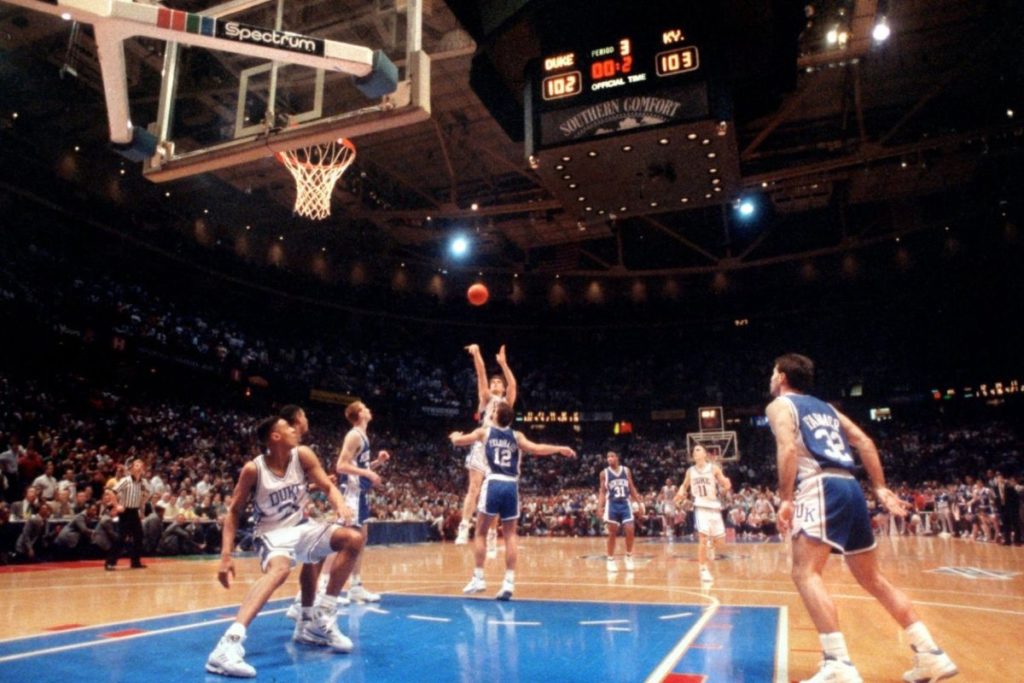
Where were you when Laettner hit “The Shot”?
I was in what passed for the den at 102 Archer in Shreveport. Casey was only three then and as Duke Blue Devils ran gleefully all over the Spectrum court in Philadelphia, I looked at him and said, “I wish you could appreciate what just happened. Or talk to me about it.”
He wouldn’t.
Kids…
Neither would John James, posted up that afternoon in a Scottsdale, Ariz., hotel room where he was “busy” working for The Times covering the Shreveport Captains and their parent club, the San Francisco Giants, in Cactus League action. I remember he was angry because whenever we covered baseball, The Times made us wear a protective cup. Odd Gannett policy, but rules is rules. Anyway…
The Duke-Kentucky game was, of course, a four-diaper game. I don’t agree or disagree, but as a point of reference, in 2004, Sports Illustrated ranked it as the greatest college basketball game ever.
It’s one of the best I’ve ever seen, no question.
For sure it was the highlight of the 1992 NCAA Tournament. It was for the final spot in the Final Four. It was tight the whole game, including the final 2.1 seconds when defending national champion Duke called time out trailing 103-102. Grant Hill’s undefended length-of-the-floor inbounds pass—Rick Pitino and his staff had decided to double-team Christian Laettner instead of guard the passer—was an overhead winner to Laettner, who caught it a couple feet from the free throw line, almost dead center, back to the basket. Fakes left, dribble once as he fakes right, turns back left and, falling away, shoots.
Duke wins, 104-103.
I had no feelings either way except appreciation for how well the game was played and how hard the game was played. I didn’t know whether to feel happier for Duke or sorrier for Kentucky. As happy as the Duke players were — remember Thomas Hill crying for joy and in disbelief, his Duke hands clasped behind his head? — the Kentucky players were probably one step on the emotion scale sadder than Duke was happy.
It really was a game in which there were no losers—but Duke advanced, and Kentucky did not. The Blue Devils would successfully defend their 1991 national title in Minneapolis, where they beat Indiana by three and, in the championship, Michigan by 20.
Laettner finished that Regional Final game against Kentucky with 31 points and 7 rebounds,10–10 from the field and 10–10 from the free throw line. Those Laettner-Hill-Bobby Hurley Duke teams were fun, fun college teams to watch.
-30-