Simple Feed

The year before I’d covered the final Final Four played in a small gym, Kemper Arena, and 1989 was the first year it would be played in a massive gym, the Kingdome in Seattle. The Kingdome has been imploded so if you go the spot where Rumeal Robinson hit the game-winning free throws with three seconds left to lift Michigan to an 80-79 victory over Seton Hall, it will not look quite the same.
But it WILL likely still be raining. As it did all that week of the 1989 Final Four. Nothing against rain. Or the Pacific Northwest. Or against lovely, clean, wet Seattle.
Maybe as the town itself is wonderful but a little different, 1989’s final weekend of basketball was the same.
Seton Hall was down by 18 points to Duke and roared back to win by 17 in a hard-to-watch second half. In the second game of the All-Big 10 semi-final doubleheader, Michigan, beaten by Illinois twice in the regular season, won an 83-81 battle against the Illini, who would finish a healthy 31-5 — but not a national champion.
As it happened in the finals the year before when Danny Manning of Kansas scored off an offensive rebound late to put the exclamation point on an 83-79 victory over Oklahoma—the Sooners had beaten the Jayhawks twice in the regular season—Michigan’s Sean Higgins grabbed a missed three-point shot and scored inside with two seconds left, a knockout blow for the Wolverines against the no-longer-Fightin’ Illini.
Illinois head coach Lou Henson’s team was ranked No. 1 at one point during the season. Henson had led the Illini to seven straight years of tournament play before reaching the Final Four — then lost to team he’d beaten twice during the regular season. Sports. Sigh…
Instead, the 1989 champion would be either Michigan or Seton Hall’s Pirates, coached by the thickly bearded P. J. Carlesimo.
This set up a title game that few if anyone saw coming. Seton Hall of New Jersey has its way with the Big East but was a 3-seed from the WEST Bracket—so the NCAA Committee made them earn it for sure—and Michigan was a 3-seed from the Southeast. And you might remember that the Wolverines were coached by Steve Fisher, who, going into the final against Seton Hall, had been their coach for — give me a second to court — five games. What? Well…
Michigan’s coach during the regular season, Bill Frieder, agreed to take the basketball job at Arizona State for the 1990 season. He told Michigan athletic director Bo Schembechler he’d stay to coach through the tournament. Schembechler said thanks but no thanks, fired him, and hired Fisher. “I don’t want someone from Arizona State coaching the Michigan team,” Schembechler said as Fisher was announced as Michigan’s new coach. “A Michigan man is going to coach Michigan.”
Is that beautiful? A guy always knew where he stood with Schembechler, who understood that spoken communication is a beautiful thing. As was this final game — until the last three seconds.
(If you want to watch a recap—the Phantom Foul is at the 9:30ish mark—go here: https://www.youtube.com/watch?v=E-sV-0zz93k
Seton Hall guard Gerald Greene was whistled for bumping or holding or breathing on Robinson, who dribbled left to right near the foul line with three seconds left and Michigan down by a point. Referee John Clougherty, a name known to every college basketball fan of that era because he’d called tons of big games and would call a dozen Final Fours in his Hall of Fame career, quickly made the call from underneath the basket. Greene’s hand had touched Robinson’s hip, but you know how you put your own hand on your hip? It was like that. Only not as hard or aggressive.
It was as if the wind had been called for a foul.
Robinson, who shot the free throws as if he were in his back yard or sitting in an easy chair, made the first to tie and the second to win. A Seton Hall shot from the time line, left side, banked long off the glass at the other end.
And that’s how the 1989 season ended: with a quick whistle and a long miss, and two cool-customer free throws in between.
The last time I saw Rumeal Robinson, he was eating at Outback Steakhouse in Shreveport after a Shreveport Crawdads game. Is that 20 years ago? He looked just as relaxed as the most recent time I’d seen him before that, from my seat to his left along the free throw line, where he sank two with :03 left to win it for Schembechler, for Fisher, and for Michigan men everywhere.
-30-
March 29, 2018
‘Batting Leadoff, For The Next 40 Years…’
Ode To An Opening Day (Rainout)
The thrill of the grass
The brown of the dirt
The smell of the leather
Wait: my jock strap hurts.
Did the equipment guys
Give me one too small?
If that’s the case
I will kill them all!
I can’t play six months
In this kind of pain.
Oh wait. Never mind.
It just started to rain.
From, “Opening Day Thoughts,” a Designated Writers Work in Progress
What does today’s Opening Day of the 2018 Major League Baseball season have to do with the end of the political career of Dave Norris, who has basically been the Babe Ruth of West Monroe as its mayor since 1978?
I shouldn’t even have to write this…but plenty.
Designated Co-Founder John James Marshall wrote in yesterday’s Daily Happen of his fascination with Mayor Norris’ career. As I heard a caller say once on sports talk radio, “I occur.”
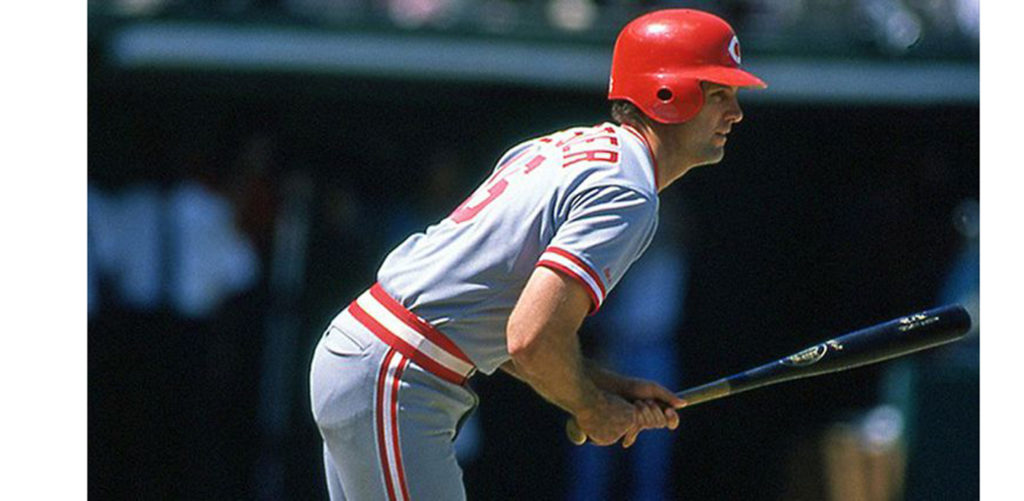
Guess who was batting leadoff for the Cincinnati Reds when Mayor Norris took office? Pete Rose. Junior Kennedy was on that team. Ron Oester (pictured above) was on that team. RON OESTER! (Oester is in the Reds Hall of Fame, by the way. Steady! There IS no baseball without the Ron Oesters of the world.)
When Kirk Gibson hit the homer off Eckersley in Game 1 of the 1988 World Series to send Los Angeles to an upset sweep of Oakland, Mayor Norris was mayor.
He was mayor when Omar Vizquel was a starter on the 1998 American League All-Star team. He was mayor during every one of Greg Maddux’s four consecutive Cy Young seasons. And he was mayor when the Houston Astros were horrible (most of the past 40 years) and when they were World Champions (now), and when West Monroe High was bad in sports (the first half of his administration) and when the Rebels were wonderful in sports (the final two decades of his administration).
How I knew Mayor Norris was as the lead singer of The Pacemakers Quartet. When we first moved to Louisiana from South Carolina, he and his singing mates were a complete fascination to me. They came and sang at our church. I might have been the only 14-year-old guy in West Monroe who could sing along with all The Pacemarkers’ songs. And that was before he was mayor, so I was not in it for the political favors.
I went to school with his nephews, had deep respect for his brother, admire his wife, and now am fortunate to work with his son. I am grateful that he has served in my mom’s hometown for 40 baseball seasons. As he does, I wish the city and the new mayor the best of everything.
It’s a new season. Let’s play ball!
-30-