Simple Feed
July 27, 2023
Beard giving back where it all began
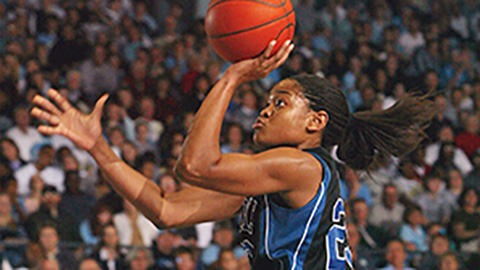
By JOHN JAMES MARSHALL/Designated Writers
For someone who had a career full of highlights, you’d think it would be easy for Alana Beard to choose one.
Think again.
WNBA Champion?
Two Final Four appearances?
Four-time WNBA All-Star?
School scoring record at Duke University?
No. 2 pick in the WNBA draft?
“That’s a tough question,” said Beard, who will be inducted into the Louisiana Sports Hall of Fame this weekend in Natchitoches.
“It’s impossible to pinpoint just one highlight because all of those have led to this moment,” Beard said. “But my high school career (at Southwood) was my foundation. The fact that we were capable of winning four state championships in a row during that span, that would be it. That was the beginning of everything else.”
The “everything else” part of it is quite substantial, because even though her playing career is over, a new career has begun. Once her amazing basketball career ended, she has continued to make her mark as founder and president of the 318 Foundation, established to help close the opportunity gap for high school girls in underserved communities.
The program, anchored by the Andre Agassi Foundation for Education, has been piloted in Shreveport and then being implemented in other locations.
Beard spent five months in 2019 in Shreveport and took it upon herself to organizing meetings with political, civic and school leaders. “I wanted to see just what was needed in Shreveport,” she said. “I’ve always been adamant about building something in Shreveport for Shreveport and I didn’t want to just let my name to something.”
Beard and Southwood set the standard for high school basketball in this area, but it came from humble beginnings. “Today’s players have so much access to skills trainers and are always evolving,” Beard said. “I was out in my backyard practicing on a dirt court. I was very fortunate to have a coach like Steve McDowell. He laid the foundation for me and gave me the skills and values that go along with being a champion in this sport.”
“She was always the first one there to practice and the last to leave,” McDowell said. “She wanted to be the very best she could be. She had such a will to win.”
Beard did plenty of it. She went on to play at Duke and became the only player in NCAA history to score 2,600 points with 500 assists and 400 steals. In 2004, she won the Wade Trophy, given to the Outstanding Player in women’s college basketball.
She began her pro career with the Washington Mystics but injuries forced her to miss two complete seasons. In 2012, she returned to play for the Los Angeles Sparks and was part of the 2016 team that won the WNBA title.
Beard retired – “probably a year too late,” she said – in 2019.
“People always say that they didn’t envision themselves being what they turned out to be, but I did,” Beard said. “Because I know the amount of work I put into it. I knew what my goals were. I trusted myself and the people I put around me. I’m grateful for everything I’ve been able to accomplish, but I also envisioned it from the get-go.
“My professional career was rewarding,” she said. “That’s the pinnacle for women’s sports. But on top of that, I was able to build relationships that I value more than anything.”
Women’s basketball certainly evolved during Beard’s career. “What I notice more than anything these days is that these women are taking ownership of who they are and to really see themselves as a business,” she said. “When you do that, you take more stake in everything else that goes in it. The way that you eat. The way that you work out. The way you present yourself on the court. And the way you present yourself off the court.”
That’s why for those in the 318 Foundation, it doesn’t matter if a student has ever shot a basketball. “We have some life-changing experiences for young girls,” Beard said. “We had two young women, who had never been out of Shreveport, in (Washington) D.C. last week at a leadership camp.”
All of the success Alana Beard has had circles back to those days practicing on that backyard dirt court and her career at Southwood.
“Shreveport raised me,” Beard said. “Shreveport is why I am who I am. I think a lot of people who are raised here go out and gain all of those experience in the world and don’t return. I’ve always wanted to be different in that sense. I’ve acquired a lot of experience over the last 20 years. What better way to share that than in the community that raised you?”
This feature first appeared in the Shreveport-Bossier Journal
July 18, 2023
Wendell Davis was way ahead of the game
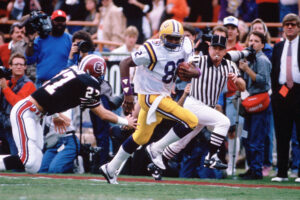
By TEDDY ALLEN/Designated Writers
A two-time All-America receiver and the SEC Player of the Year as a senior in 1987, former LSU Tiger Wendell Davis is so unassuming, so under the radar and in the moment, that how good he was can somewhat escape a lot of folks, including, of all people, Wendell Davis.
“It’s beautiful to see how the game’s evolved, especially at the receiver position,” he said from Chicago, where he’s lived and worked and raised a family since his NFL career ended after a devastating injury five games into his sixth season with the Bears in 1993. “These guys today are a lot taller, a lot faster, a lot stronger … they make such a big difference out there.”
In his LSU-loving mind are pictures of Kayshon Boutte, Justin Jefferson, Ja’Marr Chase, Jarvis Landry, Josh Reed, Odell Beckham Jr., dude after dude from the past 20 years, guys who, if you saw them walking in Baton Rouge, you’d know where they were going and why: to Tiger Stadium, to catch a bunch of footballs.
“To me,” Davis said, “as a receiver, it’s beautiful to see … the way they’re built, the way they move. They possess it all.”
He smiles — it’s a sideline-to-sideline smile, always — and he shakes his head, almost in disbelief. And then with a hint of shy amazement, one of the most prolific receivers in school history says, “I couldn’t do what they do.”
Which is fine except … well, he did.
He did what they’re doing.
And he did it before many of them were born.
While it’s been 30 years since he retired as a player and a quarter century since he finished his college career with three touchdown catches and the Most Valuable Player award in the 1987 Gator Bowl, and while the world and the game has changed plenty, the LSU record book hasn’t changed as much as you’d think.
The record shows that even the passing of time makes it impossible to overlook the accomplishments of Wendell Davis, a member of the Louisiana Sports Hall of Fame’s outstanding Class of 2023.
The Class of 2023 Induction Celebration is July 27-29 in Natchitoches. Information and tickets are available at LaSportsHall.com or by calling 318-238-4255.
“We sort of changed the SEC in the mid-’80s, the way teams had to defend; Wendell was a big part of that,” said Tommy Hodson, also a Louisiana Sports Hall of Famer and the triggerman for all those passes to Davis those final two fabulous years of Davis’s college career in 1986-87. “When you look back now, what he did still stacks up.”
Davis still holds the school record for career receptions with 183, and outside of Eric Martin — his Hall of Fame immediate predecessor at LSU — and a Todd Kinchen, Andy Hamilton and Carlos Carson dotted here and there, each an outstanding player, Davis is the only guy who played pre-2000 whose name still litters the receiving Top 10 lists, most of which he was at the top of when he left LSU as a first-round pick to Chicago.
Davis left LSU as the leader in receptions in a game (14) and in a single season (80), in single-season receiving yardage (1,244), in receiving TDs (11) in yards per game (113.1) and in career receiving yards (2,708).
Dude from Shreveport-Fair Park could play.
And remember: until the 2002-03 season, statistics in bowl games and playoff games didn’t count. Plus teams played 11 game regular seasons then, and maybe a bowl. Now a team can play as many as 15 in a season.
Take the Top 50 receivers in either catches or yardage last year in the NCAA and compare them to Davis’s junior season: only six had more yardage, only 13 had more catches, and all but two had the advantage of playing more games. Insane when considering we’re comparing today’s throw-it-everywhere game to what LSU and Davis and Hodson did 37 years ago.
The problem for defenses and the advantage for Davis and his teammates was so simple it’s elusive: nobody could cover him.
“What he did was amazing back then,” Hodson said. “It’s even more amazing today. He had a great final game in the Gator Bowl (nine catches for 132 yards and three TDs) and that doesn’t even count.
“Funny to think about it, but it started out with eight catches here, seven there, another eight or 10 …,” Hodson said. “Then the story started to grow.”
“The best thing I can say about Wendell is that as a safety, I was playing against all kinds of great receivers every week in the SEC,” said former teammate Jamie Bice. “But we knew we’d never see a better receiver on Saturday than we’d seen every day in practice in Wendell; that receiver just didn’t exist.”
The Davis Story started innocently enough when he showed up in Baton Rouge largely unannounced. He’d been recruited lightly and late by the staff of head coach Jerry Stovall, who signed Davis — right before the whole staff was fired.
Davis thought, “Uh-oh.”
“They listed me at 6-1; I’m about 5-11, really,” Davis said. “Most of my career I played at 185 to 187. Speed’s average. But the thing that stood out was that I could run routes. And I loved football and the whole team concept and I worked hard at everything I did. I was sure if I worked hard, I could be successful.
“It’s just that, with a new staff, they didn’t know what they were getting with me,” Davis said.
No. They did not. Who could have figured this average-looking mildly recruited freshman would, as a junior and senior, win so much hardware and help lead his team to a pair of Top 10 finishes.
But he did. New coach Bill Arnsparger kept the signed recruits. A defensive whiz, he bolstered the Tiger line on both sides. And in 1986, after Davis had averaged about a catch-and-a-half a game his first two seasons and Eric Martin had left for the NFL, a freshman quarterback named Hodson from Central Lafourche met Davis.
“He was highly recruited and was going to get the chance to play,” Davis said. “My thinking was I need to get to know him, and the way to do that was to really work out with him.”
Summer meant throwing and catching and talking. Understanding. And then, “the second or third game,” Hodson said, “it just kind of clicked.”
The hash marks were wider then, and Davis usually lined up as the split end to the short side. Teams blitzed a lot and played man almost exclusively.
“On the short side, Wendell’s the easier throw, the shorter throw,” Hodson said. “It just started out as a hook, an out, a fade, a go … it was easier. And his route running as so precise. And to be honest, the corners weren’t as good back then. And that’s really it. That’s how it happened.”
Eight catches here, seven there … Then the story started to grow …
“Just a lot of work,” Davis said. “At practice, getting to become comfortable with each other and trying to understand one another. But the trick was, Can we transfer that to the game field? We were able to do that.”
“We were both precise; we both had a lot of discipline,” Hodson said. “In practice if things weren’t lining up, I might ask him to put a hitch step in his route. Or he’d ask me to make it a quick five (step drop) instead of regular speed. The smallest things so we could time it all perfectly.”
If three or four QBs were in a rotation throwing to receivers at practice, Hodson might do some quick math and step out of line.
“I’m skipping,” he said, “until I get to Wendell.”
The out route and the skinny post were the duo’s “go to” throws. “You’ve got the same footwork, the same break,” Hodson said. “Wendell would give you the same look off the ball, but you didn’t know if he was going in or out.
“Or we’d run a corner from the inside slot. The defense would be in man and the guy was always running behind Wendell,” Hodson said. “All the time. I just lob it over the top and he catches it. I bet he scored 10 TDs on that one route.”
He scored the final two on that route in the Gator Bowl when he made South Carolina’s self-named “Black Death” defense look more like they were playing dead. Men against Chickens. The win was LSU’s first bowl victory since 1979 and gave the Tigers their first 10-win season in a quarter century.
(For the record, the first TD was on an out route Davis caught on the hash at the 39. Easily left his defender, juked another, raced down the sideline.)
“Everything just clicked that day,” Davis said. “We went out the way we wanted.”
The end wasn’t as wonderful with the Bears. Averaging 40-plus catches a season in his first five years in the NFL, Davis seemed heading toward a pro career similar to that of his friend Martin, who played 10 years in the league. That changed in October of 1993 at a game in Philadelphia against the Eagles when Davis tried to jump for a pass — and never left the ground. His cleats stuck in the god-forsaken AstroTurf in Veterans Stadium, and the result was a tear of both patellar tendons, the rope that keeps the kneecaps in place.
“They found my kneecaps,” Davis said, “up in my thighs.”
He tried a comeback the next fall with Indianapolis. Didn’t work.
He also got a call from Philadelphia in 2004 right before the Vet was demolished.
“They asked me if I’d like to press the button (to start the implosion),” Davis said. “I just said, ‘No thanks. I’m done. I’m good.’”
And Davis is good these days. Better than good. He says the injury helped him understand more fully that “you’re really not in control of those things, that there’s a purpose for your life,” he said. “And I also learned that it’s not about me; it’s about serving Him and serving others.”
Besides, he says now, the end of playing football was “the end of something great but the start of something awesome.”
The NFL experience, he said, “was wonderful, to be able to have some success at that level. But more important was getting married to the girl of my dreams (Trish, from Illinois) and for us to have kids and be married for the last 32 years. That’s the awesome part. Just transitioning from being a player to being able to coach, then to be a part of corporate America in business, which I love. I’m just so grateful for my opportunities.”