Simple Feed

(Ran originally in the May 12, 2019 Sunday editions of The Times and The News-Star.)
I have just finished watching the fifth installment of the Fosse/Verdon series on FX that “explores the singular romantic and creative partnership between Bob Fosse and Gwen Verdon,” the dynamic duo of a once-upon-a-time Broadway, collaborators on Damn Yankees!, Redhead, Chicago and more.
The publicity words I’ve read line up with what I just saw: “Bob is a visionary filmmaker and one of the theater’s most influential choreographers and directors, and Gwen is the greatest Broadway dancer of all time.”
You’ll like it if you’re into that sort of thing, how art is created and the uncomfortable tradeoffs sometimes made to get it done. Backstage says it might be the “TV’s first realistic picture of New York Theatre.”
The art is great—the 1970’s sets and wardrobes make you understand that era’s addictions a little better. (We wore that?) But you won’t be in so much of a romantic mood after you watch it. Whole lot of you-scratch-my-back, I’ll-scratch-yours going on. But you will want to watch a Fosse/Verdon musical. Or two or three. For sure Chicago.
Catch the replays on your DVR.
And notify your recorder of this too: Because I like to keep reminding myself that we almost certainly did win World War II but you can’t be too careful when it comes to Hitler, I keep reading WWII books and am now entrenched in one of the greatest things — speaking of television — Turner Classic Movies (TCM) has ever done or could ever do.
It began May 2, continued May 9, and will run each Thursday through June 27 as TCM commemorates the 75th anniversary of D-Day over the nine Thursdays in May and June. Our gift from TCM is 75 movies set during WWII.
It’s called “Never Surrender: WWII in the Movies.”
I surrender.
The themes are “home front” and “combat,” which explains why we won’t see aired the greatest WWII movie of them all, Casablanca. It’s tough to leave out a movie in which Humphrey Bogart looks at Ingrid Bergman and says, Humphrey Bogart-like, “I remember every detail. The Germans wore gray, you wore blue.”
Like some of you, I missed the first couple of weeks and need to catch up, sort of like Poland needed to do in ’39. But like Poland did, we will survive.
The intros and outros to the series are nicely done from the National WWII Museum in New Orleans. TCM has filmed a lot of historical segments to air with the movies.
Hurts me that Saving Private Ryan is not on the list, although like Casablanca—aired a record 150 times during TCM’s quarter-century on air, according to my friend and Louisiana Sports Hall of Fame inductee Ted Lewis, who early this week alerted me to TCM’s gift—it airs plenty.
TCM will “play it again,” just not in the next two months.
And it hurts me that Command Decision will not be shown. I think it was first a play and then turned into a movie, like A Few Good Men, a play in 1989 that became a movie in 1992. In Command Decision, Clark Gable says, “Right now they’re on oxygen 25,000 feet over Germany. Some of them will be dancing at the Savoy tonight. Some of them will still be in Germany.”
Risky business.
You’d think they’d show Midway, but they usually do show it every Memorial Day weekend, and I have to see Charlton Heston die again. Every year. I should be happy they’re giving me the year off.
For the record, here are my Top 10 WWII movies, offered with the full knowledge that I need to go back and watch many from the early 1040s—victory was still very much in the balance—that I’ve missed.
10-6: (Ones they aren’t showing, in no particular order: Saving Private Ryan, Patton, Kelly’s Heroes (not great, but to break up everything with some laughs), Where Eagles Dare (Richard Burton’s acting style vs. Clint Eastwood’s plus Ingrid Pitt? I mean, come on!) And almost making the cut, The Guns of Navarone and They Were Expendable. I have taken some liberty with math here, but all is fair in love and WWII.
FIVE B: The Bridge Over The River Kwai: Saw it around 1967 in my hometown theatre in South Carolina. Thought it had just come out; it came out in 1957. That’s how the world worked in my hometown’s sometimes-we’re-open, sometimes-we’re-not theatre.
FIVE A: Sands of Iwo Jima (1950): John Wayne and all. And a little of Adele Mara, which is better than no Adele Mara at all. If Adele is not in the movie then I don’t watch this. It was brought to my attention that this was just sort of a John Wayne in a WWII movie deal; the scales have been lifted.
FOUR: A Bridge Too Far: (1977): Love the book too. Based on the ill-fated Market-Garden operation. It’s always that one last bridge…
THREE: Tora! Tora! Tora! (1970): Saw it three times in two days when it came out. Or when it got to our town.
TWO: The Longest Day (1962): Based on Cornelius Ryan’s book, the movie’s cast includes Robert Mitchum, John Wayne, Eddie Albert, Richard Burton, Sean Connery, Henry Fonda, Roddy McDowell, George Segal, Robert Wagner…The Longest Cast.
ONE: The Great Escape (1963): James Garner, Richard Attenborough, Charles Bronson, James Coburn. Plus Steve McQueen on a motorcycle. Yessir, may I have another?
To view the full list go to tcm.com/wwii. You’re welcome. Let freedom ring.
-30-
May 13, 2019
THE 1893 WORLD’S FAIR (YOU CAN STILL MAKE IT!)
(I wrote this in 2011. The original headline, written by me, was “A better than fair fair zips toward the silver screen.” But Hollywood and all…
Anyway, “zips toward the big screen” turns out to be wrong. Instead, Variety reported in February of this year that “Hulu is developing a series based on the book The Devil in the White City: Murder, Magic and Madness at the Fair That Changed America by Erik Larson. Leonardo DiCaprio and Martin Scorsese will executive produce the project (whatever that means?) Paramount Television will produce. The book was so good, it might just be worth the wait…)
A zipper is like the world pole vault record or plumbing: you never think about it until it’s broken.
The zipper. So key. So crucial. Sleeker and faster than the cumbersome button, yet with that subtle hint of danger. You probably have one on right now. Hopefully it’s not caught in anything.
The zipper has consumed my thoughts this week because of a book I read, Devil in the White City, sequel to the bestselling Devil in My Zipper. That second part is just a joke but the first part is real, and a really good book.
Written in 2003 by Erik Larson, it’s a story of “Murder, Magic, and Madness at the Fair That Changed America,” the 1893 World’s Fair in Chicago.
I’m mentioning this in the wake of this year’s Academy Awards because Leonardo DiCaprio has bought the rights to the book; the movie is scheduled for release in 2013.
DiCaprio is signed up for the part of H.H. Holmes, who went to the fair several times and still made time to knock off, by police estimates, at least 27 people. Maybe 200. As millions of people overwhelmed the city, you can imagine how easy it would be for someone to disappear. Several did. (H.H. did it – though you’ve got to figure fair food killed a few.)
The book follows the building of the fair, a nearly impossible undertaking that Chicago and some of America’s best architects and engineers and thousands of laborers accomplished to rave reviews. Meanwhile, Holmes is juking and jiving.
How does the zipper play into all this? Did Holmes zipper people? Jack The Ripper had terrorized London less than 10 years before.
Holmes The Zipper?
Neg. What I found interesting was that the zipper was introduced at the Chicago World’s Fair. Until then, no zipper. Imagine a moment in the great Exposition Hall when a man stopped and, encountering this device on display, gasped, “Ethel! You GOTTA see this!”
The first automatic dishwasher was introduced to the world at the fair. A box with stuff inside that claimed to make pancakes, with the brand name of Aunt Jemima’s. And from different ends of the spectrum, Juicy Fruit gum and Shredded Wheat cereal. Cracker Jack. A new beer, after winning Best of Show, expanded its name to Pabst Blue Ribbon.
They even had a 22,000-pound cheese in the Wisconsin Pavilion, and it never molded, the whole summer long. I’d have liked to have attended, if I could have dodged Mr. Holmes
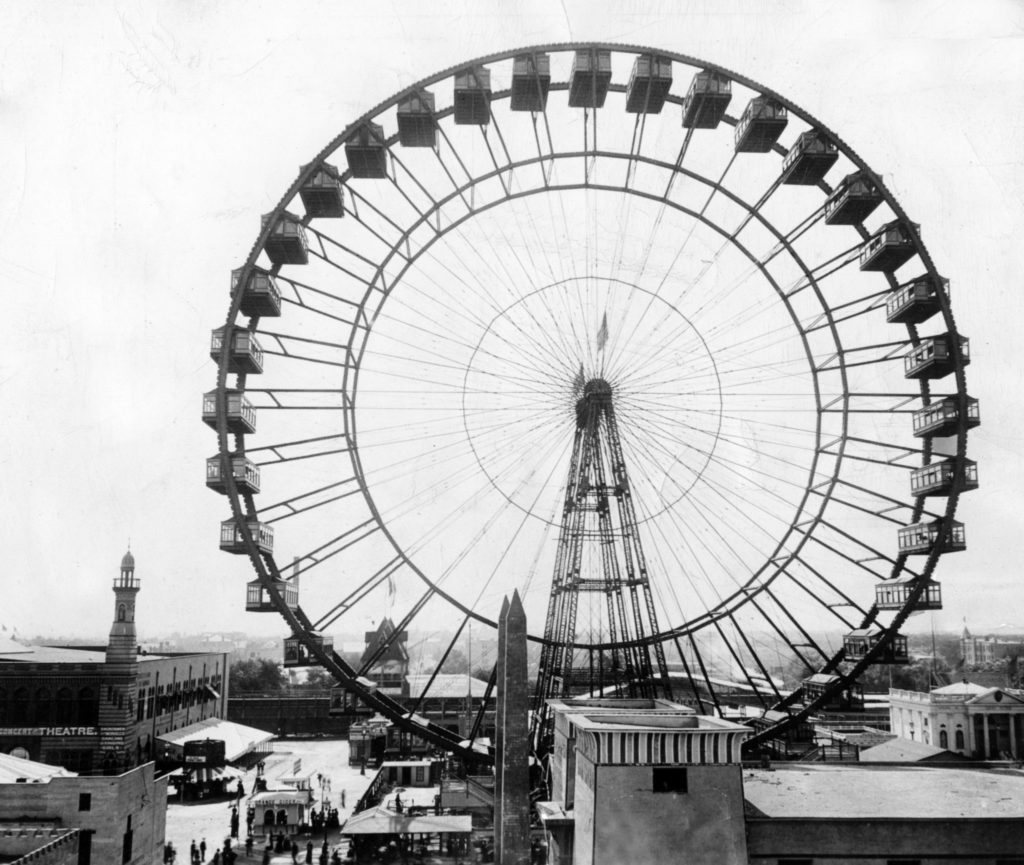
My favorite part was an invention by a 33-year-old Pittsburgh engineer. A key to global pride was building something that would “out-Eiffel Eiffel,” something that would top the tower built specifically for the International Exhibition of Paris in 1889. America was having a tough time coming up with something.
But we did. And it was perfect. What the engineer imagined was a huge success, something you’ve likely enjoyed. The original contraption – you can still see pictures online — was even transported to St. Louis and starred in the Louisiana Purchase Exposition of 1904 (“World, meet Dr Pepper!”) before it was dynamited and sold for scrap.
The engineer imagined his invention carrying 2,160 people at a time 300 feet into the air. Miraculously, it did. Major, major hit along the Midway, throughout the country and across the sea, even out-Eiffeling the Eiffel Tower.
The engineer’s name was George Washington Gale Ferris.
-30-